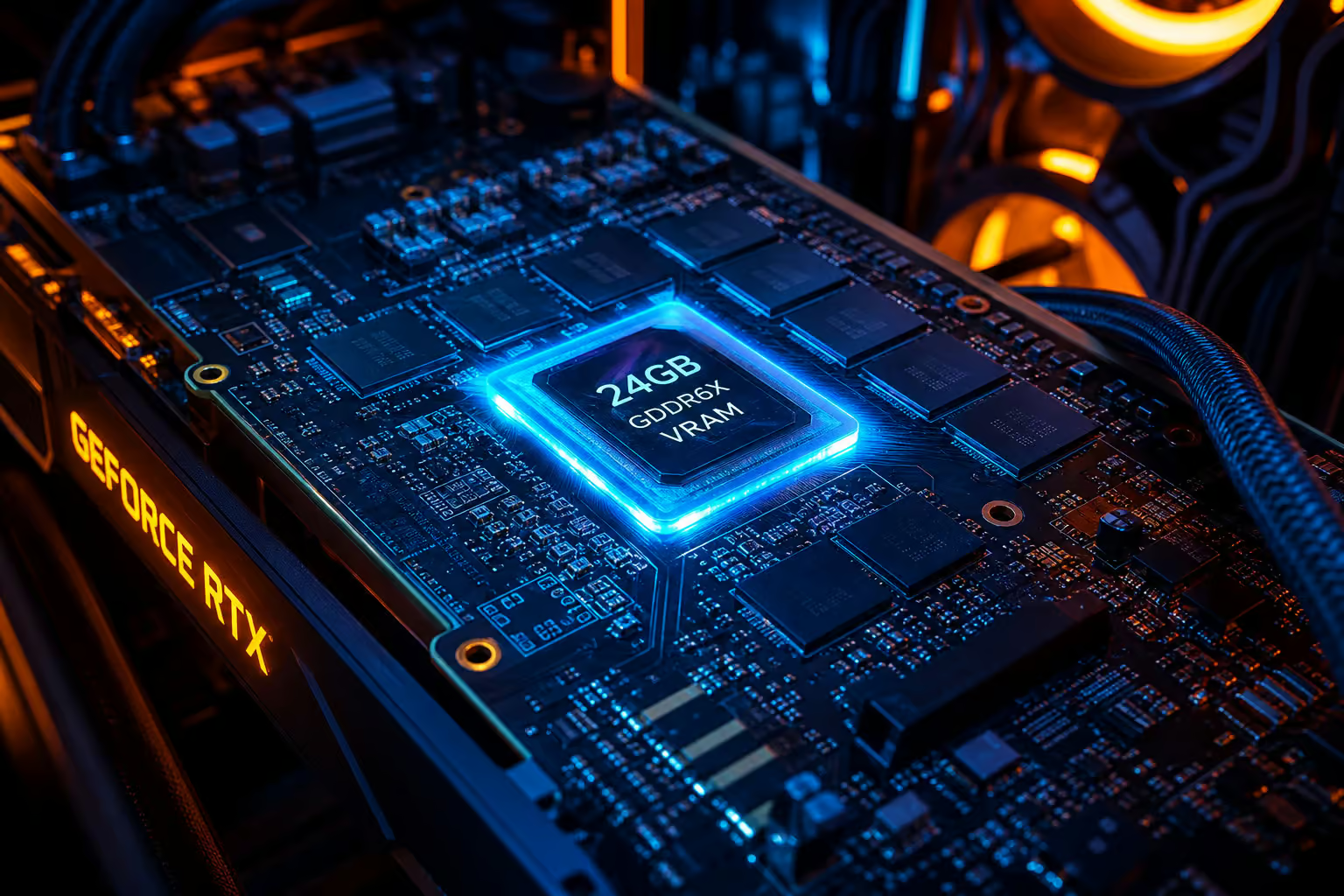
Imagine this: you’ve meticulously gathered components for a stunning, high-end PC build. You’ve got a blazing DDR5 motherboard, an elite CPU, and an impressive cable setup that could rival any sci-fi console. Yet, when you glance at your graphics card, you realize you’re stuck with an outdated, low-VRAM unit.
Instead of harnessing your system’s full potential for demanding machine learning tasks, you find yourself relegated to playing casual games on the lowest settings. It’s a frustrating imbalance: a powerful machine stifled by inadequate video memory.
This predicament mirrors the larger issue of «compute inequality» plaguing the tech industry. You’re either among the «GPU-rich»—large corporations like OpenAI or Google with deep pockets—or you belong to the «GPU-poor» community, which includes startups and independent researchers who lack access to top-tier hardware. Fortunately, being GPU-poor doesn’t spell doom; it simply means you need to think outside the box.
Key Insights on GPU Inequality
– The maximum practical limit for training large language models (LLMs) on DIY setups with M40 cards is constrained to 3 billion parameters for a feasible training timeline.
– Attempting to utilize old cryptocurrency mining rigs often fails due to a lack of unified memory, resulting in extreme latency.
– Revamping 24GB Tesla M40 boards necessitates advanced cooling techniques and adjustments to manage thermal challenges.
Table of Contents
1. Understanding the Divide in GPU Resources
2. Identifying the Line Between GPU-Haves and Have-Nots
3. The Disconnect: Why Your Gaming Setup is Limited
4. Challenges of Operating Underpowered Hardware
5. Mechanical Solutions: Breathing Life into Old Server Cards
6. The VRAM-to-Cost Equation: Tesla M40 vs. Nvidia A100
7. The Engineering Challenge: Custom Cooling and PCIe Solutions
8. Software Strategies for GPU-Poor Users
9. The Limits of Model Size and Parameter Scaling
10. Why the GPU-Poor May Outpace the Affluent
Understanding the Divide in GPU Resources
For developers operating on a shoestring budget, it’s essential to grasp the barriers separating tech giants from smaller players. This isn’t a defeatist view; it’s merely the reality of the engineering landscape.
Identifying the Line Between GPU-Haves and Have-Nots
The chasm between those with access to high-end hardware and those without often boils down to scale. Companies like OpenAI can afford extensive training cycles because they possess the resources to rent thousands of advanced chips. For smaller developers, however, this level of access is financially unfeasible.
Yet, constraint can breed innovation. The divide has given rise to open-source models and efficient resource management. If you can’t afford to brute-force your way through a model, you must become more ingenious with your software solutions.
The Disconnect: Why Your Gaming Setup is Limited
If you’re an enthusiast, you might believe your premium gaming GPU can seamlessly transition to serve as a local AI research hub. Sadly, modern consumer GPUs are designed for high-performance gaming, focusing on clock speeds and graphical rendering rather than the memory capacity needed for AI workloads.
While these gaming GPUs excel at delivering high frame rates, their limited VRAM often struggles under the weight of large language models. When your VRAM is maxed out, your system resorts to using standard RAM, leading to frustratingly slow performance.
Challenges of Operating Underpowered Hardware
Creating an economical local workspace to bypass cloud services is rewarding but comes with its own set of challenges. GPU-poor developers face hurdles like thermal management, limited power supply, and constrained VRAM during local AI training. These issues can lead to frequent maintenance and monitoring of your setup.
Many users turn to repurposed cryptocurrency mining rigs, only to discover that the performance gains are often negated by latency and compatibility issues. The fragmented nature of these setups can hinder efficiency.
High-performance enterprise systems utilize integrated, high-bandwidth connections to ensure seamless data transfer. Unfortunately, consumer-grade boards often lack this level of cohesion, resulting in inadequate performance comparable to running the model on a CPU.
Mechanical Solutions: Breathing Life into Old Server Cards
For those who enjoy hands-on projects, utilizing retired enterprise hardware can be a game-changer. These older server cards often provide significantly more VRAM than their consumer counterparts, allowing for larger-scale experiments at a fraction of the cost.
The VRAM-to-Cost Equation: Tesla M40 vs. Nvidia A100
When evaluating options, the VRAM-to-cost ratio becomes crucial. While the Nvidia A100 offers a whopping 40GB of high-speed memory, its price often makes it unfeasible for home labs. Instead, consider the Tesla M40, which delivers a generous 24GB of VRAM, enabling more extensive experimentation without the hefty price tag.
However, these cards require some modification for optimal performance, including active cooling systems and adjustments to PCIe configurations.
The Engineering Challenge: Custom Cooling and PCIe Solutions
Using legacy hardware often involves engineering challenges. Many older cards, like the Tesla M40, are designed for industrial settings with specialized cooling needs. If you attempt to run one in a standard PC case, it will likely overheat quickly.
You’ll need to create a custom 3D-printed cooling solution to ensure it stays within safe temperature limits. Additionally, PCIe scaling issues may arise, necessitating clever hacks to get your motherboard to cooperate.
Software Strategies for GPU-Poor Users
While hardware modifications are essential, optimizing your software architecture can offer significant advantages. One effective approach is to move computation from local servers to client-side solutions.
Utilizing technologies like WebGPU allows you to run inference tasks directly in the user’s browser, reducing both hosting costs and latency. This keeps your workloads efficient while maintaining low operational overhead.
The Limits of Model Size and Parameter Scaling
Despite our best efforts, there are hard limits to what we can achieve. No matter how many optimization techniques we apply, we can’t circumvent the fundamental constraints of physics.
For those using Tesla M40s with custom cooling solutions, a practical training limit is around 3 billion parameters. Going beyond this threshold significantly slows down processes, rendering them impractical for most users.
Why the GPU-Poor May Outpace the Affluent
Operating with limited resources may feel restrictive, but it can also serve as a competitive advantage. Wealthy teams often resort to expensive solutions for every problem, leading to bloated and inefficient code.
In contrast, developers who are GPU-poor must optimize every aspect of their work. This discipline fosters the creation of lean, agile products that can adapt quickly to market changes.
By maintaining a modular approach, you can ensure that your local setup remains flexible, enabling you to pivot swiftly as the landscape evolves.