The rise of perpetual futures has transformed the trading landscape, generating a staggering $61.7 trillion in volume last year alone, as reported by Reuters. This surge in popularity is attracting brokers eager to tap into this lucrative market. However, integrating perpetual contracts into their offerings involves navigating complex aspects such as funding, margin, liquidation, routing, and compliance—especially since these products operate continuously. So, what makes perpetual futures so appealing yet challenging for brokers?
Understanding Perpetual Futures: No Expiry and Unique Mechanics
Perpetual futures, or «perps,» allow traders to take long or short positions without a specific expiration date. Unlike traditional futures contracts, which require settlements at predetermined intervals, perps remain active as long as the trader meets margin requirements. This flexibility has not only drawn interest from crypto traders focusing on Bitcoin and Ethereum but is now extending to foreign exchange, equities, and even pre-IPO markets.
Funding Rates: The Key to Perpetuals
One of the main challenges with perpetual contracts is the absence of a natural convergence point between the contract price and the spot price. To address this issue, perps employ a funding rate mechanism—essentially a periodic payment exchanged between long and short holders. If the perp is trading above the underlying index, the long position pays the short position, and vice versa. This structure differs from standard overnight CFD fees because it’s a direct transfer between traders rather than a broker charge.
How Liquidation Works in Perpetual Futures
In the world of perps, liquidation is an integral part of the trading process. When a trader’s equity falls below a specified maintenance margin, their position may be automatically closed. Brokers employ different margin structures: isolated margin ties collateral to individual positions, while cross margin allows the entire account balance to support multiple positions. Although cross margin can be more efficient, it also carries risks, as losses in one position can impact others.
The Role of Mark Price
Brokers calculate margin and liquidation thresholds based on a «mark price,» which is usually linked to an index rather than the last traded price. This approach protects clients from being liquidated due to temporary price fluctuations. For brokers, the mark price is crucial for determining unrealized profit and loss, margin requirements, and liquidation decisions.
Comparing Perpetuals, CFDs, and Traditional Futures
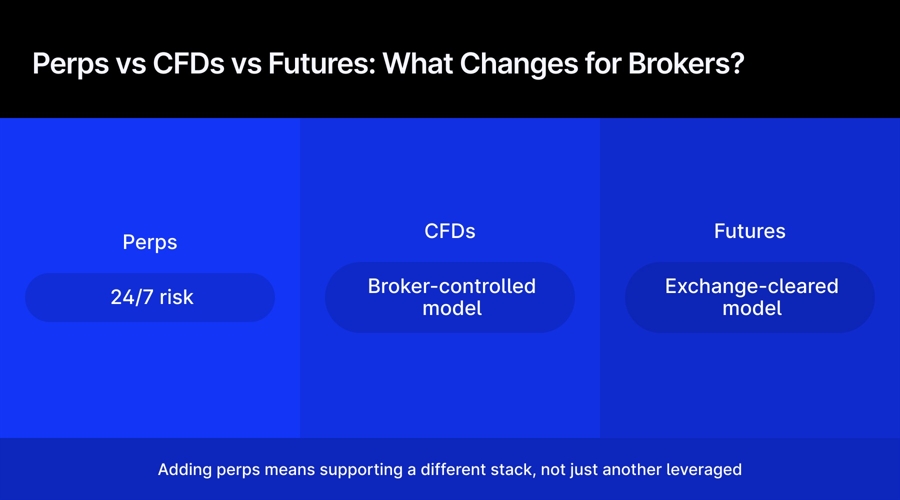
Perpetual futures, contracts for difference (CFDs), and traditional futures all provide leveraged exposure to the market. However, they differ significantly in their funding mechanisms, margin structures, and regulatory environments. While perps and crypto CFDs may appear similar to clients, brokers must navigate a more complicated landscape involving funding rates, mark price logic, and venue regulations.
The Broker’s Dilemma: To Offer or Not to Offer?
Before bringing perpetual futures to market, brokers must answer several critical questions: What is the legal status of the product? How will trades be routed? How will risk be managed? And who is the target market? Each jurisdiction has its own regulations, making it essential for brokers to understand the landscape in which they operate.
For instance, some companies may choose to list products directly, while others might route trades to established exchanges or use white-label solutions. Additionally, providers like Coinbase have taken steps to connect U.S. users to global liquidity through compliant channels, highlighting the importance of strategic partnerships.
Risk Management and Client Suitability
Risk management is vital when dealing with perpetual futures. Brokers need to understand how mark prices are calculated, who controls the underlying index, and how often funding is settled. Moreover, client suitability becomes increasingly important, especially in retail settings where funding mechanics can complicate the economics of a position.
As retail participants become more involved, brokers face additional obligations such as ensuring that clients are equipped to understand the risks involved. This includes appropriateness checks and compliance with local regulations, which may impose restrictions on marketing and distribution.
The U.S. Market Landscape: Emerging Routes for Perpetuals
In the U.S., several regulated avenues for perpetual futures are being developed. These can range from directly listed contracts to long-dated futures wrappers. Early data suggests a rapid uptake of these products, with some firms reporting significant trading volumes shortly after launch. However, critics caution that high leverage and automatic liquidation can pose risks, especially for retail investors who may not fully grasp the funding mechanics.
Regulatory Considerations and Market Dynamics
Regulators are closely scrutinizing the rapid growth of perpetual futures. In Europe, for example, the ESMA has emphasized the importance of product substance over mere branding. Derivatives marketed as perpetual futures may fall under existing regulatory measures, which could impose leverage limits and mandatory risk warnings to protect investors.
The conversation around regulatory frameworks is ongoing, and as more brokers consider entering this space, they must balance the potential for profit with the complexities and risks inherent in offering perpetual futures.
By understanding the multifaceted nature of perpetual futures, brokers can make informed decisions about whether to incorporate these products into their offerings. As the market continues to evolve, staying ahead of regulatory changes and understanding client needs will be crucial to success.