Understanding Prediction Markets: How They Work and Why They Matter
Prediction markets are becoming increasingly popular as a way to forecast future events, from political elections to weather changes. But what truly sets them apart from traditional betting platforms? These markets operate on a unique premise that allows participants to buy and sell contracts based on the outcomes of real-world events. You might be curious about how these systems function and their implications for both traders and society. Let’s dive in and explore the fascinating world of prediction markets, their mechanics, and their impact on decision-making.
What Are Prediction Markets?
Prediction markets are platforms where individuals can trade contracts based on anticipated future events. Unlike standard polls, which simply gather opinions, these markets require financial commitment. When you buy a contract, you indicate your belief about the likelihood of an event occurring.
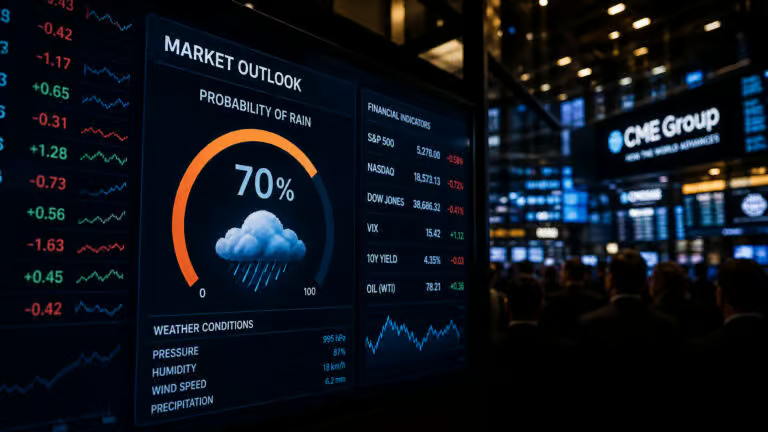
For example, consider a contract asking, «Will it rain tomorrow?» If you purchase a «Yes» contract for $0.70, you’re essentially stating that you believe there’s a 70% chance of rain. This financial stake differentiates prediction markets from casual surveys, as it pushes participants to think critically and back their opinions with real money.
What Are Event Contracts?
Event contracts are the fundamental units traded in prediction markets. They operate similarly to binary options, where you can either win or lose based on the outcome of a specified event. If you buy a contract predicting rain and it does rain, you gain a payout; if not, you lose your investment.
The simplicity of this structure is attractive, but as with any financial instrument, complexity can arise. Some contracts might involve multiple outcomes or conditions, making them more intricate to trade. However, the core principle remains: the price of a contract reflects the market’s collective belief in the event’s probability.
Why Participate in Prediction Markets?
People engage in prediction markets for two main reasons: hedging and speculation.
-
Hedging: This strategy involves using contracts to mitigate risks. For instance, a farmer might buy a weather contract to protect against potential crop losses due to freezing temperatures.
-
Speculation: On the flip side, traders seek profit by betting on outcomes they believe are undervalued. This is often where significant financial losses occur, as speculation can lead to irrational choices driven by emotion rather than data.
Understanding these motivations can help you navigate the prediction market landscape better.
How Prices Are Determined in Prediction Markets
Prediction markets utilize two main pricing mechanisms: Central Limit Order Books (CLOB) and Automated Market Makers (AMM).
-
CLOB: This traditional model allows participants to place buy and sell orders, which are matched based on supply and demand. As a result, prices are determined by the traders’ actions.
-
AMM: This model ensures liquidity by always being ready to trade at set prices based on a formula. It allows for continuous trading, even when there are few participants.
Both methods have their pros and cons, affecting how easily you can enter or exit trades.
Accuracy of Prediction Markets
The accuracy of prediction markets can be a double-edged sword. On one hand, studies indicate that they often outperform traditional polls, particularly in political elections. However, discrepancies can arise, especially when markets collectively anchor on certain prices, leading to a phenomenon known as the favorite-longshot bias.
In a significant analysis of over 300,000 contracts, it was found that while markets can provide insightful forecasts, most individual traders end up losing money. This paradox highlights the importance of understanding market dynamics before diving in.
Challenges and Failures in Prediction Markets
Prediction markets are not immune to failure. Historical examples, such as the 2016 US presidential election, demonstrate how collective sentiment can mislead traders. When the market consensus becomes an echo chamber, new information may be disregarded, leading to inaccurate predictions.
Other challenges include manipulation attempts and speculative bubbles, where the market can be driven by emotion rather than rationality. Awareness of these potential pitfalls is crucial for anyone looking to participate.
Resolution and Oracles: Who Decides the Outcome?
The resolution of contracts in prediction markets is vital. The rules surrounding this process can significantly impact traders. In regulated environments, outcomes are determined by predefined criteria, ensuring transparency. However, decentralized platforms may use less clear methods, which can lead to disputes and confusion.
Understanding the resolution rules before entering a market is essential to safeguarding your investment.
The Evolution of Prediction Markets
Prediction markets have a rich history, dating back centuries. They have evolved from informal betting practices to sophisticated platforms that leverage technology for data aggregation. The modern landscape includes both regulated exchanges and decentralized options, each bringing its unique features and challenges.
The Regulatory Environment of Prediction Markets
The legal status of prediction markets varies widely across jurisdictions. In the U.S., they are primarily regulated as derivatives, but ongoing legal battles could reshape the landscape. Understanding the applicable laws in your region is crucial for anyone considering participation.
Consumer Protections and Responsible Trading
Awareness of your rights as a trader is essential. Regulatory bodies enforce rules to protect consumers, ensuring transparency about risks and fees. Always approach prediction markets with caution, trading only what you can afford to lose.
The Prediction Market Ecosystem
The ecosystem of prediction markets encompasses a variety of platforms, from academic tools to commercial applications. Each offers different features, fees, and levels of accessibility. Choosing the right platform depends on your goals, risk tolerance, and the type of events you wish to trade.
In summary, prediction markets offer a compelling blend of crowdsourced forecasting and financial opportunity. Whether you’re hedging against risks or speculating on outcomes, understanding the mechanics and challenges of these markets is key to navigating this evolving landscape.